
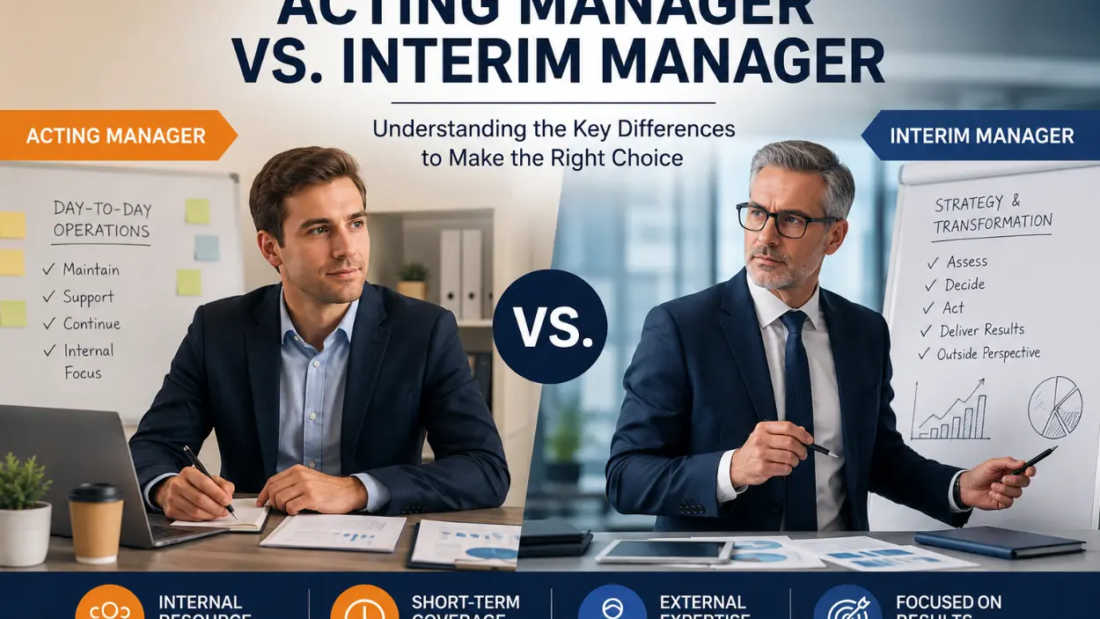
Acting Manager vs. Interim Manager

Acting Manager vs. Interim Manager: What’s the Real Difference?

People use these two terms like they mean the same thing, and honestly, it’s an easy mistake to make. Both involve someone stepping into a leadership role temporarily. Both show up when there’s a gap that needs filling fast. But the similarities pretty much stop there, and the difference actually matters a lot once you’re the one making the decision.

Here’s how to tell them apart, and why picking the right one can save your business a lot of trouble.

What an Acting Manager Actually Is

An acting manager is almost always someone already inside your company. Say your operations director goes on extended leave, or leaves suddenly and a replacement hasn’t been found yet. Rather than bring in someone new, you promote a trusted employee, maybe a deputy or a senior team member, to cover the role temporarily.

It’s a practical, low-friction solution. The person already knows the business, the team, the systems, and the culture. There’s no ramp-up time because they’re not learning the company, they’re just learning the new responsibilities that come with the title.

But that’s also where the limits show up. An acting manager usually hasn’t done the top job before. They’re stepping up, not stepping in from experience. And because they’re still part of the internal structure, there’s often an unspoken understanding that they’re keeping the seat warm rather than making bold changes. Nobody wants to overhaul the department they might not be leading in six months.

What an Interim Manager Actually Is

An interim manager is a different animal entirely. This is a senior, experienced professional brought in from outside the organization, specifically because the situation calls for someone who’s done this exact job, in this exact type of crisis or transition, before.

They’re not there to keep things running quietly. They’re there to make decisions, take ownership, and often push through changes that internal politics would normally slow down. Because they have no history with the company, no loyalties to protect, and usually no interest in staying on permanently, they can make the calls that need making without worrying about how it affects their next promotion.

This is the model Octobiz works within. Our interim managers step into real operational and executive roles with full authority to act, not just observe, and they bring outside experience from having handled similar situations across different businesses and sectors. That outside perspective is often exactly what a company under pressure needs.

The Core Differences, Side by Side

Where they come from. Acting managers come from inside the company. Interim managers come from outside it.

Experience level. Acting managers are usually stepping into a role for the first time. Interim managers have typically done this specific type of leadership work multiple times before, often in comparable crisis or transition scenarios.

Objectivity. An acting manager still has to work alongside the same colleagues once the interim period ends, so there’s a natural hesitation to rock the boat. An interim manager has no such constraint. They can make the hard calls because they’re not sticking around for the fallout.

Purpose. Acting management is mostly about continuity, keeping the lights on until someone permanent is found. Interim management is about intervention, actively fixing a problem, driving a transformation, or steering a business through a specific challenge.

Cost and structure. Acting managers are usually paid at a modified version of their existing salary. Interim managers are engaged on a contract basis, for a defined period and a defined outcome, which tends to reflect the seniority and specialization they bring.

So Which One Does Your Business Actually Need?

If the gap is short-term and mostly administrative, an acting manager can absolutely get the job done. But if your business is dealing with something bigger, financial distress, a stalled turnaround, a leadership vacuum during a major transition, or a situation that needs someone who has genuinely handled this exact scenario before, that’s when interim management is the stronger move.

This is where Octobiz comes in. We don’t send someone in to simply hold the fort. Our interim managers take real operational responsibility, bring outside experience that internal candidates usually can’t offer, and focus entirely on solving the problem in front of them, without the internal politics that can slow everything down.

If your business is facing a leadership gap right now and you’re not sure whether an internal promotion or an outside interim leader is the right call, it’s worth talking it through. Reach out to Octobiz and we’ll help you figure out what the situation actually needs.

What Is Interim Management, and Why Are So Many Companies Using It Now

What Is Interim Management, and Why Are So Many Companies Using It Now?

If you’ve spent any time around boardrooms lately, you’ve probably heard the phrase “interim management” thrown around more than usual. It’s not new, but it’s having a moment. And once you understand what it actually means, it’s easy to see why.

The Short Version

Interim management is the practice of bringing in an experienced, senior professional on a temporary basis to fill a critical leadership gap. Not a consultant who hands you a slide deck and walks away. Not a permanent hire you’re locked into for years. Someone who steps into the role itself, often within days, and actually runs the show while your company figures out its next move.

Think of it like this: your CFO resigns unexpectedly in the middle of a funding round. Or your operations director leaves right before a major product launch. You can’t leave that seat empty, but you also don’t have three months to run a proper executive search. That’s the gap interim management fills.

Why Companies Reach for It

There are a handful of situations where interim management makes sense, and they show up more often than people expect.

Sudden departures. Executives leave for all kinds of reasons, health, opportunity, personal circumstances. When it happens without warning, someone needs to hold the ship steady while a permanent replacement is found.

Mergers and acquisitions. Integrating two companies is messy. An interim leader with M&A experience can manage the transition without the politics that sometimes come with promoting from inside either organization.

Financial distress or restructuring. This is where interim management overlaps heavily with turnaround work. A business under pressure often needs a leader who’s dealt with cash flow crises before and isn’t learning on the job.

Rapid growth or new market entry. Scaling fast, or expanding into a new country, requires a specific kind of experience that not every internal team has yet.

Specialized, short-term projects. Sometimes you just need someone with a very particular skill set for a defined period, not a permanent headcount.

How It’s Different From Hiring a Consultant

This trips people up a lot, so it’s worth being direct about it. A consultant advises. An interim manager acts.

Consultants typically sit outside the organization, study the problem, and hand back recommendations. It’s then up to your internal team to implement whatever they’ve suggested, which is often where things stall.

An interim manager takes the job itself. They have decision-making authority, they sign off on changes, they’re accountable for results, and they’re in the building (or on the calls) every day making it happen. It’s a completely different level of involvement.

What a Good Interim Manager Actually Brings

The best interim managers aren’t just available fast. They bring:

  • Immediate credibility. They’ve usually done this exact type of role before, often multiple times, in similar situations.
  • No political baggage. They’re not angling for a promotion or protecting a legacy project. Their only job is to fix the problem in front of them.
  • Speed. A good interim placement can be operational within a week or two, compared to the months a traditional executive search usually takes.
  • Objectivity. Coming from outside the business, they can see what’s actually going wrong without the blind spots that build up over years inside a company.

Is It Right for Your Business?

If your company is dealing with a leadership vacancy, financial strain, a stalled transformation, or a transition that needs steady hands, interim management is worth a serious look. It’s not a sign of weakness to bring in outside leadership, if anything, it’s usually a sign that a business is being proactive rather than hoping the problem sorts itself out.

The key is finding people who’ve genuinely been in the seat before, not just advised from a distance.

Where Octobiz Fits In

This is exactly the space Octobiz works in. We don’t send in a junior team to observe and report back. Our interim managers step directly into operational and executive roles, bring real accountability with them, and get to work solving the actual problem, whether that’s a cash flow crisis, a leadership gap ahead of a major transition, or a business that just needs someone experienced to take the wheel for a while.

If your business is facing a gap that needs filling now, not in three months, it’s worth a conversation. Get in touch with Octobiz and let’s talk about what interim leadership could look like for your business.

Business Restructuring

Meaning and Impact of Business Restructuring

  • Improved Financial Health: The reorganization of debt and capital can alleviate financial pressures, making the company more solvent and stable.
  • Increased Efficiency: Streamlined processes and a leaner workforce often lead to higher productivity and reduced operational costs.
  • Enhanced Strategic Focus: By divesting non-core assets or units, companies can concentrate on areas with the most potential for growth.
  • Revitalized Culture: A well-managed restructuring can boost morale by clarifying roles, eliminating redundancies, and introducing new leadership.
  • Greater Market Competitiveness: Restructured companies are often better positioned to respond to opportunities and threats in their industry.
  • Negative Impacts

    • Job Losses: Downsizing and layoffs are common, which can lead to lower morale and loss of institutional knowledge.
    • Disruption: Major changes can disrupt day-to-day operations, affect productivity, and create uncertainty among employees and stakeholders.
    • Costs: The restructuring process itself can be expensive, involving legal, consulting, and severance costs.
    • Reputation Risk: If not managed transparently, restructuring can damage relationships with customers, suppliers, and the public.

    Ultimately, the outcome depends on the clarity of the restructuring vision, the skill of its execution, and the engagement of key stakeholders.

    Timeline of Business Restructuring

    The restructuring process is complex and varies depending on company size, industry, and reasons for change. However, a typical timeline can be outlined as follows:

    • Assessment (1-2 months): Management and advisors conduct a thorough analysis of the company’s financial, operational, and market position. This phase identifies the need for restructuring and possible options.
    • 2. Strategy Development (1-2 months): Based on the assessment, leaders design a restructuring plan, set objectives, and determine the necessary steps and resources.
    • 3. Stakeholder Engagement (Ongoing): Throughout the process, it’s crucial to communicate with employees, creditors, shareholders, customers, and regulators to build support and manage expectations.
    • 4. Implementation (3-12 months): The company executes the restructuring plan – this may include staff reductions, asset sales, refinancing, or business process changes.
    • 5. Monitoring and Adjustment (Ongoing, at least 6-12 months): After implementation, progress is tracked, and adjustments are made as necessary to ensure objectives are met.

    The entire process, from assessment to stabilization, can range from several months to multiple years, especially in large and complex organizations.

    Real-Life Examples of Successful Business Restructuring

    1. IBM (International Business Machines Corporation)

    In the 1990s, IBM faced declining revenue as demand for mainframe computers waned. Under the leadership of CEO Lou Gerstner, IBM undertook a dramatic restructuring – shedding non-core businesses, reducing its workforce, and pivoting from hardware to services and software. The company’s new focus on IT consulting and solutions, combined with cultural change and operational efficiency, restored growth and profitability, transforming IBM into a global technology leader.

    2. General Motors (GM)

    During the 2008-2009 global financial crisis, GM filed for Chapter 11 bankruptcy and underwent a massive government-supported restructuring. The company closed unprofitable plants, discontinued several brands, renegotiated labor contracts, and improved operational efficiency. Emerging from bankruptcy, GM became a leaner, more focused enterprise and returned to profitability, remaining one of the world’s largest automakers.

    3. Marvel Entertainment

    Marvel filed for bankruptcy in 1996 after years of financial trouble. The company restructured by cutting costs, consolidating its divisions, and licensing its characters for movies and merchandise. This led to the creation of Marvel Studios and the launch of the Marvel Cinematic Universe – a strategic move that propelled Marvel from bankruptcy to a multibillion-dollar entertainment powerhouse.

    4. Nokia

    Once the world’s largest mobile phone manufacturer, Nokia struggled with the rise of smartphones. In response, the company restructured by selling its phone division to Microsoft and focusing on telecommunications infrastructure and technology services. This pivot allowed Nokia to regain stability and find success in a new sector.

    5. Delta Air Lines

    After filing for bankruptcy in 2005, Delta underwent an extensive restructuring process that included route optimization, cost reductions, and a renewed focus on customer service. The airline emerged from bankruptcy stronger, merged with Northwest Airlines, and became one of the most profitable and admired airlines in the world.

    Conclusion

    Business restructuring is a complex but essential tool for corporate renewal and growth. When implemented thoughtfully, it can address critical challenges, position organizations for new opportunities, and secure a lasting competitive edge. The process requires clear vision, strategic planning, effective leadership, and above all, transparent communication. As demonstrated by many of the world’s leading companies, successful restructuring is not only about survival – it is a catalyst for transformation and future success.

    Meaning and Impact of Business Restructuring

    Introduction

    In the fast-paced and ever-changing world of business, companies must adapt to survive and thrive. One of the most significant mechanisms for adaptation is business restructuring – a process that can fundamentally change the structure, strategy, and operations of an organization. Whether prompted by financial distress, evolving markets, technological disruption, or new strategic directions, restructuring is a powerful tool that can rejuvenate a business, optimize performance, and secure long-term prosperity. This article delves into the meaning of business restructuring, its purpose and impact, a typical timeline, and provides real-life examples of successful transformations.

    What Is Business Restructuring?

    Business restructuring refers to the comprehensive reorganization of a company’s structure, operations, management, or finances. It is not simply a matter of cost-cutting or minor adjustments, but rather a strategic initiative that often involves significant changes such as mergers, acquisitions, divestitures, bankruptcy filings, debt renegotiations, downsizing, or even shifting the company’s primary focus.

    There are several forms of restructuring, including:

    • Financial Restructuring: Adjusting the capital structure – such as refinancing debt, issuing new equity, or negotiating with creditors – to improve financial stability.
    • Operational Restructuring: Reconfiguring business processes, supply chains, or human resources to enhance efficiency and productivity.
    • Organizational Restructuring: Changing reporting lines, management structures, or the distribution of responsibilities to better support strategic goals.
    • Strategic Restructuring: Divesting non-core assets, entering new markets, or acquiring complementary businesses to reposition the company for growth.

    The Purpose of Business Restructuring

    The primary purpose of business restructuring is to improve performance and ensure the long-term health of the organization. This can be driven by a variety of factors:

    • Responding to Crisis: Companies facing bankruptcy, unsustainable debt, or severe market downturns may restructure to stay afloat.
    • Enhancing Competitiveness: To remain competitive, businesses may need to streamline operations, reduce costs, or refocus on core activities.
    • Adapting to Market Changes: Shifts in consumer demand, technological advancements, or regulatory changes often require a new business model.
    • Preparing for Growth: Sometimes restructuring is proactive, preparing an organization for expansion, mergers, or entering new markets.
    • Maximizing Shareholder Value: By optimizing structure and operations, companies can increase profitability and return on investment.

    In summary, the underlying purpose is to position the company for success, whether by mitigating risks, capturing new opportunities, or recovering from setbacks.

    The Impact of Business Restructuring

    The impact of restructuring can be profound, both within the organization and in the broader market. Its effects can be positive or negative, depending on the execution, communication, and underlying circumstances.

    Positive Impacts

    • Improved Financial Health: The reorganization of debt and capital can alleviate financial pressures, making the company more solvent and stable.
    • Increased Efficiency: Streamlined processes and a leaner workforce often lead to higher productivity and reduced operational costs.
    • Enhanced Strategic Focus: By divesting non-core assets or units, companies can concentrate on areas with the most potential for growth.
    • Revitalized Culture: A well-managed restructuring can boost morale by clarifying roles, eliminating redundancies, and introducing new leadership.
    • Greater Market Competitiveness: Restructured companies are often better positioned to respond to opportunities and threats in their industry.

    Negative Impacts

    • Job Losses: Downsizing and layoffs are common, which can lead to lower morale and loss of institutional knowledge.
    • Disruption: Major changes can disrupt day-to-day operations, affect productivity, and create uncertainty among employees and stakeholders.
    • Costs: The restructuring process itself can be expensive, involving legal, consulting, and severance costs.
    • Reputation Risk: If not managed transparently, restructuring can damage relationships with customers, suppliers, and the public.

    Ultimately, the outcome depends on the clarity of the restructuring vision, the skill of its execution, and the engagement of key stakeholders.

    Timeline of Business Restructuring

    The restructuring process is complex and varies depending on company size, industry, and reasons for change. However, a typical timeline can be outlined as follows:

    • Assessment (1-2 months): Management and advisors conduct a thorough analysis of the company’s financial, operational, and market position. This phase identifies the need for restructuring and possible options.
    • 2. Strategy Development (1-2 months): Based on the assessment, leaders design a restructuring plan, set objectives, and determine the necessary steps and resources.
    • 3. Stakeholder Engagement (Ongoing): Throughout the process, it’s crucial to communicate with employees, creditors, shareholders, customers, and regulators to build support and manage expectations.
    • 4. Implementation (3-12 months): The company executes the restructuring plan – this may include staff reductions, asset sales, refinancing, or business process changes.
    • 5. Monitoring and Adjustment (Ongoing, at least 6-12 months): After implementation, progress is tracked, and adjustments are made as necessary to ensure objectives are met.

    The entire process, from assessment to stabilization, can range from several months to multiple years, especially in large and complex organizations.

    Real-Life Examples of Successful Business Restructuring

    1. IBM (International Business Machines Corporation)

    In the 1990s, IBM faced declining revenue as demand for mainframe computers waned. Under the leadership of CEO Lou Gerstner, IBM undertook a dramatic restructuring – shedding non-core businesses, reducing its workforce, and pivoting from hardware to services and software. The company’s new focus on IT consulting and solutions, combined with cultural change and operational efficiency, restored growth and profitability, transforming IBM into a global technology leader.

    2. General Motors (GM)

    During the 2008-2009 global financial crisis, GM filed for Chapter 11 bankruptcy and underwent a massive government-supported restructuring. The company closed unprofitable plants, discontinued several brands, renegotiated labor contracts, and improved operational efficiency. Emerging from bankruptcy, GM became a leaner, more focused enterprise and returned to profitability, remaining one of the world’s largest automakers.

    3. Marvel Entertainment

    Marvel filed for bankruptcy in 1996 after years of financial trouble. The company restructured by cutting costs, consolidating its divisions, and licensing its characters for movies and merchandise. This led to the creation of Marvel Studios and the launch of the Marvel Cinematic Universe – a strategic move that propelled Marvel from bankruptcy to a multibillion-dollar entertainment powerhouse.

    4. Nokia

    Once the world’s largest mobile phone manufacturer, Nokia struggled with the rise of smartphones. In response, the company restructured by selling its phone division to Microsoft and focusing on telecommunications infrastructure and technology services. This pivot allowed Nokia to regain stability and find success in a new sector.

    5. Delta Air Lines

    After filing for bankruptcy in 2005, Delta underwent an extensive restructuring process that included route optimization, cost reductions, and a renewed focus on customer service. The airline emerged from bankruptcy stronger, merged with Northwest Airlines, and became one of the most profitable and admired airlines in the world.

    Conclusion

    Business restructuring is a complex but essential tool for corporate renewal and growth. When implemented thoughtfully, it can address critical challenges, position organizations for new opportunities, and secure a lasting competitive edge. The process requires clear vision, strategic planning, effective leadership, and above all, transparent communication. As demonstrated by many of the world’s leading companies, successful restructuring is not only about survival – it is a catalyst for transformation and future success.