

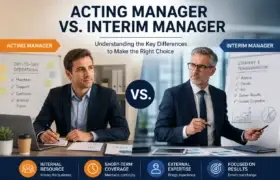
People use these two terms as if they meant the same thing, and it’s an easy mistake to make. Both involve someone stepping into a leadership role temporarily. Both show up when there’s a gap that needs filling fast. But the similarities pretty much stop there, and the difference actually matters a lot once you’re the one making the decision.
Here’s how to tell them apart, and why picking the right one can save your business a lot of trouble.
What an acting manager actually is
An acting manager is almost always someone already inside your company. Say your operations director goes on extended leave, or leaves suddenly and a replacement hasn’t been found yet. Rather than bring in someone new, you promote a trusted employee, maybe a deputy or a senior team member, to cover the role temporarily.
It’s a practical, low-friction solution. The person already knows the business, the team, the systems, and the culture. There’s no ramp-up time because they’re not learning the company, they’re just learning the new responsibilities that come with the title.
But that’s also where the limits show up. An acting manager usually hasn’t done the top job before. They’re stepping up, not stepping in from experience. And because they’re still part of the internal structure, there’s often an unspoken understanding that they’re keeping the seat warm rather than making bold changes. Nobody wants to overhaul the department they might not be leading in six months.
What an interim manager actually is
An interim manager is a different animal entirely. This is a senior, experienced professional brought in from outside the organization, specifically because the situation calls for someone who’s done this exact job, in this exact type of crisis or transition, before.
They’re not there to keep things running quietly. They’re there to make decisions, take ownership, and often push through changes that internal politics would normally slow down. Because they have no history with the company, no loyalties to protect, and usually no interest in staying on permanently, they can make the calls that need making without worrying about how it affects their next promotion.
This is the model Octobiz works within. Our interim managers step into real operational and executive roles with full authority to act, not just observe, and they bring outside experience from having handled similar situations across different businesses and sectors. That outside perspective is often exactly what a company under pressure needs.
The core differences, side by side
Where they come from. Acting managers come from inside the company. Interim managers come from outside it.
Experience level. Acting managers are usually stepping into a role for the first time. Interim managers have typically done this specific type of leadership work multiple times before, often in comparable crisis or transition scenarios.
Objectivity. An acting manager still has to work alongside the same colleagues once the interim period ends, so there’s a natural hesitation to rock the boat. An interim manager has no such constraint. They can make the hard calls because they’re not sticking around for the fallout.
Purpose. Acting management is mostly about continuity, keeping the lights on until someone permanent is found. Interim management is about intervention, actively fixing a problem, driving a transformation, or steering a business through a specific challenge.
Cost and structure. Acting managers are usually paid at a modified version of their existing salary. Interim managers are engaged on a contract basis, for a defined period and a defined outcome, which tends to reflect the seniority and specialization they bring.
So which one does your business actually need?
If the gap is short-term and mostly administrative, an acting manager can absolutely get the job done. But if your business is dealing with something bigger, financial distress, a stalled turnaround, a leadership vacuum during a major transition, or a situation that needs someone who has genuinely handled this exact scenario before, that’s when interim management is the stronger move.
This is where Octobiz comes in. We don’t send someone in to simply hold the fort. Our interim managers take real operational responsibility, bring outside experience that internal candidates usually can’t offer, and focus entirely on solving the problem in front of them, without the internal politics that can slow everything down.
If your business is facing a leadership gap right now and you’re not sure whether an internal promotion or an outside interim leader is the right call, it’s worth talking it through. Reach out to Octobiz and we’ll help you figure out what the situation actually needs.