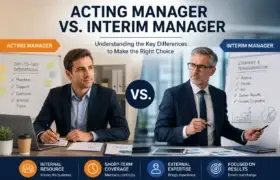
If you’ve spent any time around boardrooms lately, you’ve probably heard the phrase “interim management” thrown around more than usual. It’s not new, but it’s having a moment. And once you understand what it actually means, it’s easy to see why.
The short version
Interim management is the practice of bringing in an experienced, senior professional on a temporary basis to fill a critical leadership gap. Not a consultant who hands you a slide deck and walks away. Not a permanent hire you’re locked into for years. Someone who steps into the role itself, often within days, and actually runs the show while your company figures out its next move.
Think of it like this: Your managing director resigns unexpectedly in the middle of a funding round. Or your operations director leaves right before a major product launch. You can’t leave that seat empty, but you also don’t have three months to run a proper executive search. That’s the gap interim management fills.
Why companies reach for it
There are a handful of situations where interim management makes sense, and they show up more often than people expect.
Sudden departures. Executives leave for all kinds of reasons: Health, opportunity, personal circumstances. When it happens without warning, someone needs to hold the ship steady while a permanent replacement is found.
Mergers and acquisitions. Integrating two companies is messy. An interim leader with M&A experience can manage the transition without the politics that sometimes come with promoting from inside either organization.
Financial distress or restructuring. This is where interim management overlaps heavily with turnaround work. A business under pressure often needs a leader who’s dealt with cash flow crises before and isn’t learning on the job.
Rapid growth or new market entry. Scaling fast, or expanding into a new country, requires a specific kind of experience that not every internal team has yet.
Specialized, short-term projects. Sometimes you just need someone with a very particular skill set for a defined period, not a permanent headcount.
How it’s different from hiring a consultant
This trips people up a lot, so it’s worth being direct about it. A consultant advises. An interim manager acts.
Consultants typically sit outside the organization, study the problem, and hand back recommendations. It’s then up to your internal team to implement whatever they’ve suggested, which is often where things stall.
An interim manager takes the job itself. They have decision-making authority, they sign off on changes, they’re accountable for results, and they’re in the building (or on the calls) every day making it happen. It’s a completely different level of involvement.
What a good interim manager actually brings
The best interim managers aren’t just available fast. They bring:
- Immediate credibility. They’ve usually done this exact type of role before, often multiple times, in similar situations.
- No political baggage. They’re not angling for a promotion or protecting a legacy project. Their only job is to fix the problem in front of them.
- Speed. A good interim placement can be operational within a week or two, compared to the months a traditional executive search usually takes.
- Objectivity. Coming from outside the business, they can see what’s actually going wrong without the blind spots that build up over years inside a company.
Is it right for your business?
If your company is dealing with a leadership vacancy, financial strain, a stalled transformation, or a transition that needs steady hands, interim management is worth a serious look. It’s not a sign of weakness to bring in outside leadership. If anything, it’s usually a sign that a business is being proactive rather than hoping the problem sorts itself out.
The key is finding people who’ve genuinely been in the seat before, not just advised from a distance.
Where Octobiz fits in
This is exactly the space Octobiz works in. We don’t send in a junior team to observe and report back. Our interim managers step directly into operational and executive roles, bring real accountability with them, and get to work solving the actual problem, whether that’s a cash flow crisis, a leadership gap ahead of a major transition, or a business that just needs someone experienced to take the wheel for a while.
If your business is facing a gap that needs filling now, not in three months, it’s worth a conversation. Get in touch with Octobiz and let’s talk about what interim leadership could look like for your business.