Companies rarely fail overnight. By the time a crisis is visible to everyone, usually when the bank asks for a meeting or payroll gets tight, it has often been building for a year or more. What separates a recoverable business from one that cannot be saved is rarely how severe the symptoms look. It is how much time and room to maneuver are left when management starts to act.
This article explains how a company crisis typically unfolds, which warning signs we look for first when we assess a business, and the five questions that decide whether a turnaround can still work.
How a company crisis unfolds
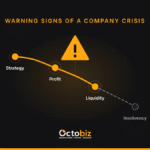
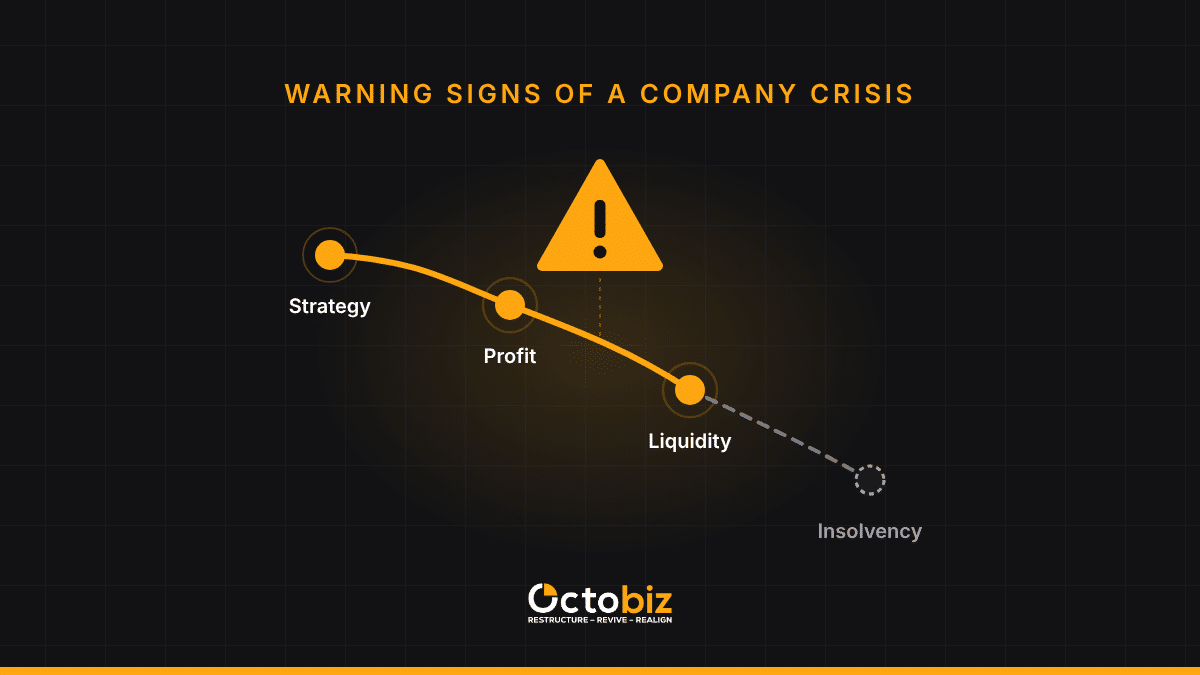
Turnaround practitioners describe a crisis in four stages. It starts as a strategic crisis. The business model loses ground, products age or a key customer quietly shifts volume to a competitor, but the numbers still look acceptable. It becomes a profitability crisis when margins and earnings start to fall. A liquidity crisis follows when losses and working capital consume cash faster than the company can generate or borrow it. At the end stands insolvency, when the company can no longer pay its debts as they fall due or its liabilities exceed its assets.
Every stage removes options. In a strategic crisis, management can still choose where to invest and what to stop. In a profitability crisis, it can still restructure costs on its own timetable. In a liquidity crisis, the agenda is set by the weekly cash position and by creditors. This is why detecting a crisis early is worth more than any single measure taken later.
Twelve warning signs, grouped by where they show up
A single signal can have a harmless explanation. What we look for in an RXI™ recoverability scan is a combination of signals that point in the same direction, and the speed at which they are moving.
In the financials
- Gross margin falls for several quarters in a row while revenue holds, which usually means that pricing power or cost control is slipping.
- Days sales outstanding rise, or a growing share of receivables is more than 60 days overdue.
- Inventory grows faster than sales, tying up cash in stock that may never sell at full price.
- EBITDA no longer covers interest, lease payments and the capital expenditure needed to keep the business running.
In cash and financing
- Credit lines are fully drawn at month end and are only relieved for a few days by large customer payments.
- Suppliers are paid beyond agreed terms, and payments to tax authorities or social security funds are deferred.
- Covenant headroom shrinks, or the company has to ask its lenders for waivers.
- Credit insurers reduce their limits on the company, and suppliers start asking for prepayment or shorter terms.
In the organization
- Monthly management accounts arrive later each month, and forecasts keep missing.
- Key people in sales, finance or operations leave, often the ones with the best options elsewhere.
- Management spends most of its time firefighting and preparing bank meetings instead of working with customers.
- Decisions on obvious problems, such as a loss-making product line or an unprofitable site, are postponed again and again.
In our work we use a simple test. If three or more of these signs apply and at least one of them comes from the cash and financing group, the company should treat the situation as a potential liquidity crisis and not as a weak year.
Five questions that decide recoverability
Warning signs describe how sick a company is. Whether it can recover depends on different factors. When we assess a business, we work through five questions.
- Is there a viable core? We look for a part of the business that earns a positive contribution margin at realistic prices and would be profitable without the loss-makers. If no profitable core remains even after restructuring, more financing only delays the outcome.
- How long is the liquidity runway? Measures need time to work. Cost reductions often take one to three months to show up in cash, while working capital measures can work within weeks. If the runway is shorter than the time the measures need, the company needs bridge financing or a formal restructuring process from the start.
- Is the problem operational or in the balance sheet? A company with a sound operating business but too much debt needs a financial restructuring. A company that loses money in its operations needs an operational turnaround first. Many companies need both, and the order matters.
- Will the stakeholders support a plan? Lenders, shareholders, credit insurers, key customers and key suppliers all have to stay on board. Their support depends on a credible plan, on management credibility and on how early and openly they are informed.
- Can management deliver? A turnaround is a second full-time job on top of running the business. The question is whether the current team has the capacity and experience to do both, or whether it needs reinforcement, for example a chief restructuring officer.
Why timing also has a legal side
Directors’ duties tighten as a crisis deepens. In Germany, the StaRUG requires the management of corporations to continuously monitor developments that could endanger the company’s continued existence and to take countermeasures. Once a company is illiquid or overindebted, the Insolvency Code requires a filing without undue delay, at the latest within three weeks of illiquidity or six weeks of overindebtedness. In the UK, directors who keep trading after they knew, or should have concluded, that there was no reasonable prospect of avoiding insolvent liquidation can be held personally liable for wrongful trading. Most other jurisdictions have comparable rules.
An early and documented assessment therefore protects both the company and its directors. This section is a general overview and not legal advice. Once warning signs accumulate, directors should also consult a restructuring lawyer in their jurisdiction.
How Octobiz thinks about this
A pattern we see often is that management noticed the first warning signs long before it acted. The reason is rarely a lack of information. It is the hope that the next quarter will turn things around, combined with the fear that an outside assessment will make the problem official.
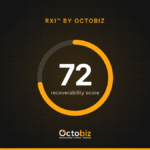
Our view is that the cheapest moment for an honest assessment is before the bank asks for one. This is why we built the RXI™ recoverability scan as a fixed-fee first step. The scan uses financial statements, current management accounts, open item lists, the bank overview and a structured questionnaire. Within three working days of payment and complete data, it delivers the type of distress, a recoverability index from 0 to 100 with reasoning, an estimated liquidity runway, the top five red flags and a go or no-go recommendation for a rapid rescue plan, including the right package size. A partner walks through the results in a call of up to 60 minutes.
The scan costs a flat €7,500, credited in full toward a rapid rescue plan. If the answer is no-go, we say so clearly, and we do not sell a rescue plan for a business that cannot be saved.
Frequently asked questions
What are the first warning signs of a company crisis?
The earliest signs usually appear in the financials. Gross margins fall, receivable days rise, inventory grows faster than sales and forecasts keep missing. Liquidity problems tend to follow later, once the profitability crisis has used up cash reserves.
How can I tell whether my company is in a liquidity crisis?
Typical signs are credit lines that are fully drawn at month end, supplier and tax payments that are being deferred, and suppliers or credit insurers who tighten their terms. A 13-week cash flow forecast shows in which week cash will run short.
Can a company still be saved once it has liquidity problems?
Often yes, if three conditions are met. The company needs a viable core business, a liquidity runway long enough for measures to work and the support of its key stakeholders. Without a profitable core, a turnaround rarely succeeds.
When should a company bring in turnaround support?
As soon as several warning signs point in the same direction, and in any case before covenants are breached or payments to tax authorities fall behind. The earlier a company acts, the more options it keeps.
What is a recoverability scan?
A recoverability scan is a structured, fixed-fee assessment of whether a company can be turned around and how urgently it needs to act. The Octobiz RXI™ scan delivers the type of distress, a recoverability index from 0 to 100, the liquidity runway, the top five red flags and a go or no-go recommendation within three working days of payment and complete data.
RXI™ Recoverability Scan
Not sure where you stand? Start with the scan.
Within three working days of receiving your data, you get a written answer on whether and how your company can be turned around. The scan is based on your financial data and our own AI engine, RXI™, and a partner reviews every result.
Fixed fee of EUR 7,500, fully credited toward a rescue plan.