
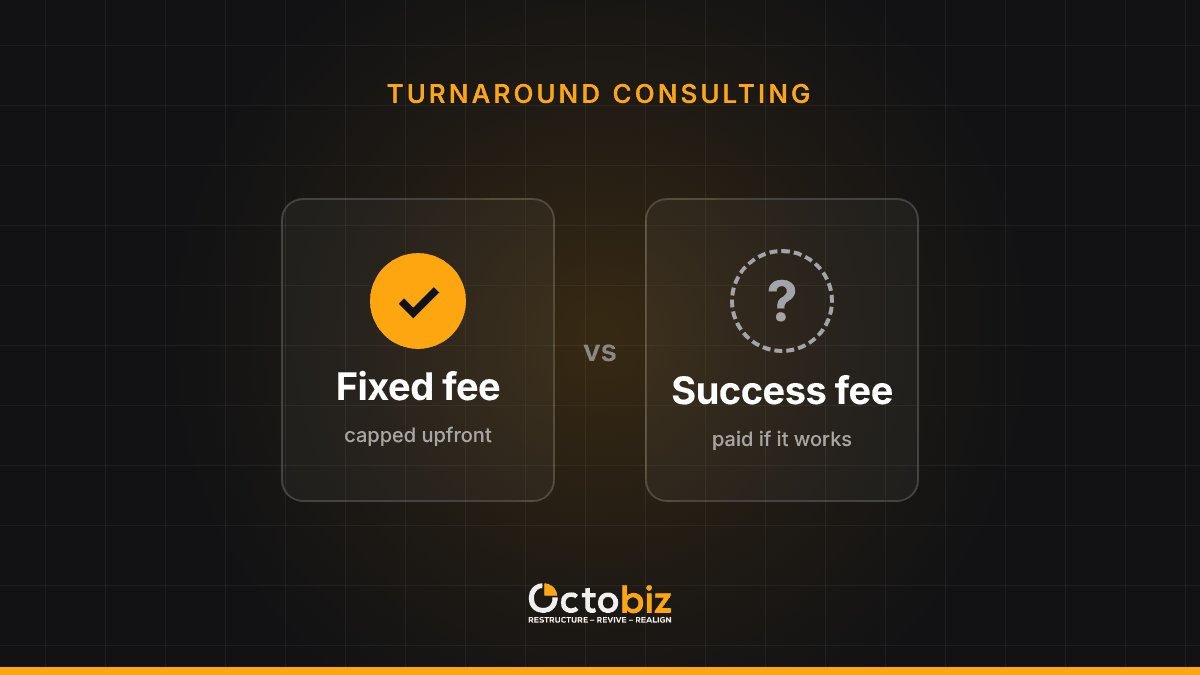
Turnaround consulting is priced in three ways: Day rates, fixed fees per phase, or success fees linked to results. The difference is not the price. It is who carries the risk. With day rates the company pays whether or not the plan works. With a fixed fee the cost of a defined piece of work is capped before it starts. With a success fee the advisor shares the risk, and the company shares the upside. Octobiz works with a fixed fee to start and performance-linked fees for execution. This article explains why, and what each model means for a company that is running out of time.
Day rates: Flexible, and open-ended
Most large restructuring practices bill by the day. The model is flexible, which matters when the scope is unclear, and it is transparent in the sense that every hour is documented. Its weakness is the open clock. A company in a liquidity crisis has no budget for a month of fact-finding, and a board that approves a day-rate engagement does not know what it will cost until it is over. In practice, day rates favor the advisor with the largest team.
Fixed fees: Cost certainty for a defined result
A fixed fee works when the deliverable can be defined before the work starts: A recoverability scan, a rescue plan with a 13-week liquidity plan and a measures catalog, a board presentation. The company knows the price, the timeline and the result in advance. The advisor carries the risk of underestimating the effort, which is why fixed fees only work for firms that have done the same thing many times and use tools that make the data work predictable. For Octobiz, that tool is AI: The first draft of the plan exists before the first day on site, so the three weeks go into judgment and iteration, not into reconciling ledgers.
Fixed fees have a second effect that is easy to underestimate. They change the conversation with the bank. A lender who sees a fixed-price, time-boxed plan with a defined result is more willing to grant the standstill that buys the time to deliver it.
Success fees: Aligned, with caveats
A success fee links the advisor’s pay to a result: A standstill, a refinancing, a cash target, an EBITDA improvement. The alignment is real. The caveats are, too. Success fees only make sense for execution, where the advisor actually controls the outcome. They are hard to define for a diagnosis or a plan, where the result depends on decisions the board has not yet taken. And in an insolvency, a fee that was contingent on survival is the first one creditors question. That is why Octobiz uses performance components only in Stage 2, prefers to have them paid by the sponsor, and never for the scan or the plan.
What this means for a company in crisis
- Agree the scope of the diagnosis in writing before committing to a full mandate. A recoverability scan at a flat fee is the cheapest way to find out whether a plan is worth paying for.
- Ask every provider how the fee depends on your outcome, and who carries the risk if the plan takes longer than promised.
- Insist on a defined deliverable and a defined date for the plan. If the answer is “it depends”, the clock is open.
- Use performance-linked fees where the advisor runs execution, and have them paid by the sponsor where possible.
How Octobiz prices a mandate
Stage 0, the RXI™ recoverability scan, costs €7,500 flat and is credited toward Stage 1. Stage 1, the rapid rescue plan, is a fixed fee from €54,000 plus 10% flat expenses, payable in advance, in three packages depending on complexity. Stage 2, execution with an interim chief restructuring officer, is a monthly retainer paid in advance with an optional performance component. There are no day rates, and additional work is only done by change order with its own fixed price.
Frequently asked questions
Why do most restructuring firms use day rates?
Because the scope of a restructuring is rarely clear at the start and day rates transfer that risk to the client. Firms that standardize their deliverables and use AI for the data work can offer fixed fees instead.
Are fixed fees more expensive than day rates?
Not necessarily. A fixed fee includes the risk premium of the advisor, but it caps the cost and removes the incentive to extend the engagement. For a time-boxed deliverable like a rescue plan, it is usually cheaper than an open clock.
Can a success fee be challenged in an insolvency?
A fee contingent on the survival of the company can be questioned by creditors if the company later fails. This is one reason to keep success components for execution and have them paid by the sponsor where possible. Take legal advice in your jurisdiction.