A company with €50 to 500 million in revenue that runs into a crisis has four kinds of help to choose from: The restructuring practice of a Big Four or large consulting firm, a specialist restructuring boutique, an interim management network, or a hands-on turnaround boutique. Each is right for a different situation. This article sets out the differences and explains how AI has changed the economics of the smaller firms.
The four provider types
- Big Four and large restructuring firms: Strongest at formal reports (IDW S6 opinions, independent business reviews) and at very large, multi-jurisdiction cases. Large teams, junior pyramid, day rates. Best when your lenders require a formal opinion or the case is above €500 million.
- Specialist restructuring boutiques: Focused advice on the plan and the lender negotiation, usually partner-led, often former Big Four. Best when you need an adviser for the plan and the bank talks, and you can execute yourself.
- Interim management networks: Place individual executives from a pool. Best when the gap is a single leadership role and the plan already exists.
- Hands-on turnaround boutiques, such as Octobiz: Diagnosis, plan and execution in one mandate, with partners who take operational responsibility. Best when you need someone to run the turnaround, not only advise on it.
Five questions to ask any provider
- Track record: How many turnarounds have they led in companies like yours, with their own P&L responsibility?
- Bank acceptance: Have lenders worked with their plans? Ask for examples.
- Operational control: Will they run the turnaround, or only advise?
- Fee alignment: How does their fee depend on your outcome? Who carries the risk if it takes longer?
- Speed: How soon can someone senior be on your premises? In a liquidity crisis, days count.
Where the large firms win, and where they do not
If your lenders require an IDW S6 opinion, a formal independent business review or a restructuring plan under a court-supervised procedure, you need an auditor or a large practice, and no boutique should pretend otherwise. The same applies to groups above €500 million with financing in several jurisdictions.
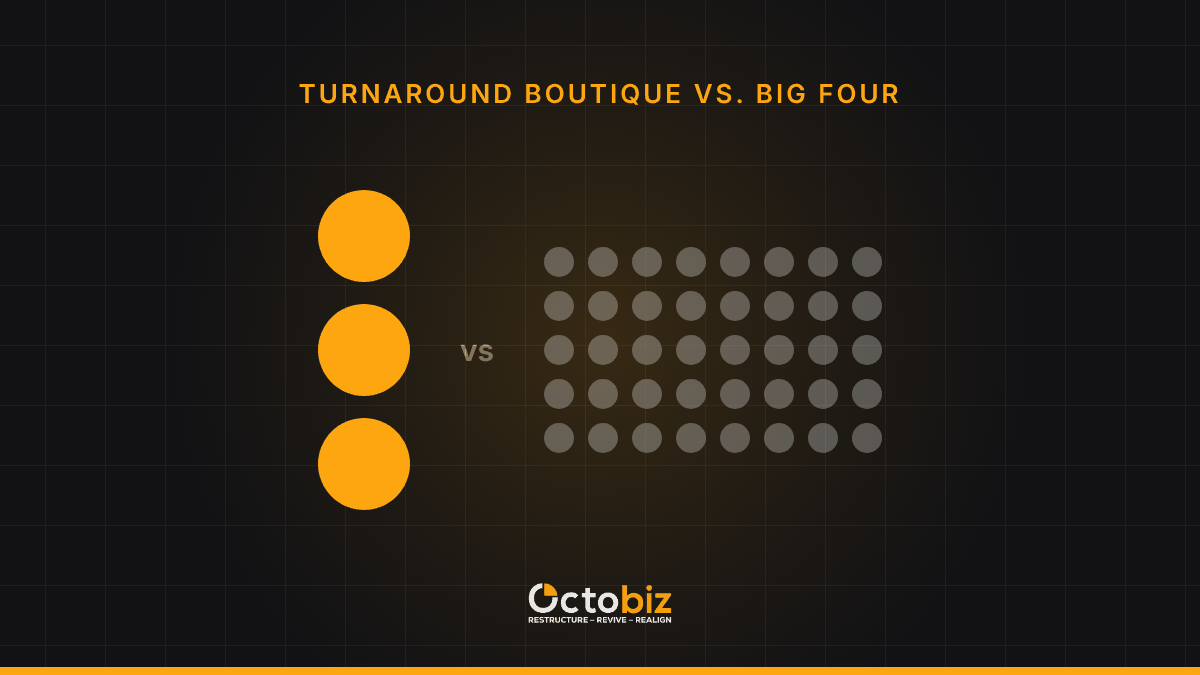
Below that threshold the picture changes. A mid-sized company does not need forty consultants. It needs three people who have run a company, a plan the bank can work with and someone who stays when the plan meets reality. The large firm’s model, a partner who visits and a pyramid of juniors who collect the data, is expensive precisely where it adds the least.
How AI changed the economics of the boutique
The junior pyramid existed for a reason: Someone had to reconcile three years of ledgers, build the cash model and draft the deck. That work now takes hours, not weeks. Octobiz’s own engine, RXI™, types the distress and scores recoverability in three working days. The AI drafts the 13-week cash view and the first measures catalog before the first day on site. The partners spend their time on judgment, negotiation and leadership, which is what the client is actually paying for.
The result is a different offer: A senior team instead of a junior pyramid, a first rescue plan draft within one week instead of a month of fact-finding, and a fixed fee instead of an open clock. It is not that large firms do not use AI. It is that a boutique built around it can pass the saving on as speed and price.
A practical way to decide
Start with a recoverability scan at a flat fee. It tells you in three working days what kind of distress you are in and whether a rescue plan is worth commissioning. If the answer is a balance-sheet case with complex financing, the scan will say so and you can bring in the right lender advisors. If it is an operational case, a hands-on boutique with a fixed-fee plan and an interim chief restructuring officer is usually the faster and cheaper route.
Frequently asked questions
Is a turnaround boutique cheaper than a Big Four practice?
For a mid-sized company, usually yes, because the deliverable is time-boxed and priced as a fixed fee instead of day rates for a large team. For formal opinions and very large cases, the large firms remain the right choice.
Can a boutique deliver a plan a bank accepts?
Yes, if the plan contains what lenders need: A 13-week liquidity plan, measures with cash effect, owners and dates, and scenarios including a downside case. Where the bank requires a formal IDW S6 opinion, an auditor writes it on the basis of that plan.
What does Octobiz charge?
A fixed fee to start: €7,500 for the RXI™ recoverability scan, from €54,000 for the rapid rescue plan. Execution is a monthly retainer with an optional performance component.
RXI™ Recoverability Scan
Not sure where you stand? Start with the scan.
Within three working days of receiving your data, you get a written answer on whether and how your company can be turned around. The scan is based on your financial data and our own AI engine, RXI™, and a partner reviews every result.
Fixed fee of EUR 7,500, fully credited toward a rescue plan.